Archive for the ‘Foundation’ Category
Hell Froze Over?
So we had a very interesting milestone at Eclipse yesterday. Our first ever committer from Sun committed code to CVS. Suresh Raju contributed code to get Eclipse working on Solaris x86. Welcome Suresh!
We were first introduced to the Solaris x86 team by Simon Phipps, who runs open source strategy over at Sun.
When you think of it, this just makes really good sense. The Solaris x86 team is working to enable one of the most popular development tools for its platform. As they should.
I am very happy to see that sound business decisions are replacing rhetoric in the relationship between Sun and Eclipse. This is a small step forward, but it is a very tangible and pragmatic one.
For those who enjoy the never-ending Swing vs. SWT debate, the amusing thing is that the component the Suresh has commit rights to is org.eclipse.swt.gtk.solaris.x86. The title of this post says the rest 😉
Swing over to Google…
…and check out the new Google Web Toolkit.
Not only does it have some really cool AJAX-enabling technology, it ships both JDT and SWT. The embedded GWT browser is built with SWT for use during development.
From an email from Bret Taylor, the PM on the project:
GWT has two components: a Java-to-JavaScript compiler, a command line tool that translates Java to JavaScript; and a “hosted web browser,” a special web browser used to debug GWT applications … The hosted web browser uses SWT since it has a UI. It is a very simple UI (a window, toolbar, and embedded browser control, basically).
Conference Frenzy
So last week was two conferences:
- JAX/Eclipse Forum Europe in Wiesbaden, Germany. (A beautiful city, by the way.)
- LinuxDays.ch in Geneva, Switzerland.
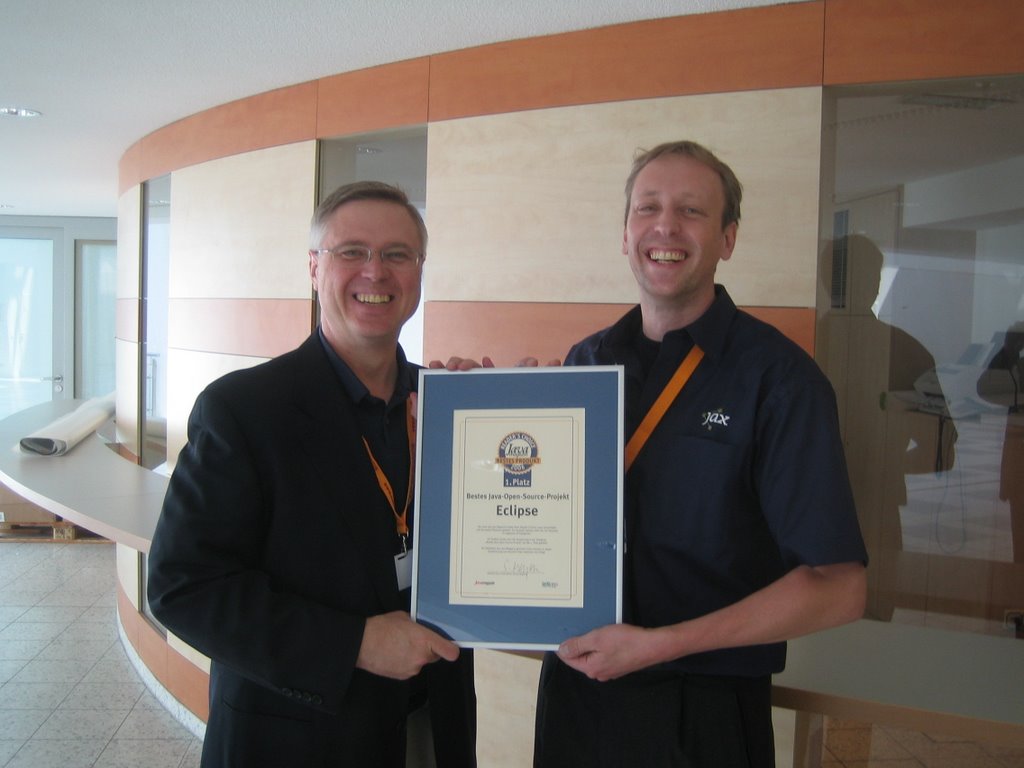
While at JAX, the editor of JavaMagazin, Alexander Neumann presented Eclipse with their Reader’s Choice Award for Best Open Source Project. Congratulations to the entire Eclipse team!
This week I’m off to JavaOne, where Bjorn and I are giving a talk on the Callisto Simultaneous Release. If you’re there, please say hi, and don’t forget to join the party at the Thirsty Bear.
No Enemies There
I, like many others, have enjoyed reading Ed Burnette‘s recent series on Sun joining Eclipse.
Personally, I think it would be great to have Sun join Eclipse. It is obviously one of the questions I’ve been asked a lot since starting at Eclipse, and my answer has been the same since the beginning: Sun would be welcomed with open arms. Eclipse is an open community, and everyone can join. And Ed is definitely correct in pointing out all the wonderful stuff that NetBeans could offer if the communities were working together.
There was one paragraph in Ed’s latest post that I did think was off the mark, however.
History is replete with examples of “mortal enemies” becoming fast friends. And in a world with Microsoft, Ruby, PHP, Linux, Web2.0, and other forces knocking on the door, these two need all the friends they can get.
First, Eclipse is absolutely not in competition with Ruby, PHP, Linux, et al. They are just additional languages and platforms for Eclipse to work with. RadRails is a great example of a cool tool built with Eclipse that embraces Ruby, rather than tries to compete with it. The Eclipse Linux initiative is another great opportunity for co-operation, rather than competition. And, of course, there are great things happening with PHP and Eclipse. In fact, I would go so far to say that Eclipse’s willingness to embrace all of these different platforms is one of the key strengths of our community. Sun has a vested interest in promoting Java against Ruby, PHP, etc., but Eclipse clearly does not.
Secondly, even in quotes, I don’t like to chararcterize competitors as “mortal enemies”. Sun and NetBeans are following a path which they believe is a sound business strategy. I personally think that co-operation would be better than competition, but hey, it takes two to tango. But I’ve met quite a few of the NetBeans folks, and they seem like perfectly nice guys doing their job. A little friendly competition never hurt anyone.
P.S. We’re not changing the name.
Antoine
No, that’s not the name of a new committer 🙂
Project Antoine is a really interesting idea. UBC is running Project Antoine to collect information on how people are actually using Webtools. The information will be used to improve usability.
If you’re an Eclipse WTP user, please help out by installing the plugin (based on Mylar) that tracks user interactions.
 Life at Eclipse