Maturity Models for Open Source Adoption
I’ve been meaning to blog on this for what feels like forever. I’m glad to finally have a moment to write this up.
Back on April 21st, I was one of a number of presenters at an event here in Ottawa put together by the Ottawa Centre for Research and Innovation (OCRI) on Competing With Open Source Software. By far and away, my favourite presentation was from Peter Carbone, the Acting CTO of Nortel. He focused on a maturity model for open source adoption that was developed by researchers at my alma mater Carleton University with support and involvement from Nortel.
The maturity model really resonated with me. It felt exactly right, given the experiences I’ve had here at Eclipse.
The six stages of maturity identified were:
- Stage 0: Denial – open source has no value, or we’re not using it.
- Stage 1: Use – passive use of FLOSS.
- Stage 2: Collaboration – contribute code and/or resources.
- Stage 3: Champion – executive support, project leadership.
- Stage 4: Strategic – defined business model based on FLOSS, and drive projects to achieve business goals.
- Stage 5: Aggressive – design products so that they can be based on FLOSS, obtain competitive advantage by harnessing changes in multiple ecosystems.
Within the Eclipse ecosystem we can see companies at every stage of this maturity model. We’re constantly working with organizations who are interested in getting to the next level of maturity.
In addition to the maturity model itself, I felt that this statement under success factors is particularly applicable to Eclipse: “Ability to appropriate co-created value is more important than lowering costs“. I think that statement really defines what brings so many companies to participate in Eclipse projects, where they can collaborate on the platform and then compete with the products they build on top.
I would be really interested in hearing comments on this maturity model and presentation. Like I said, I felt it was very good and really captured what we’re experiencing at Eclipse. Has anyone seen another maturity model that they feel is superior to this?
I Highly Recommend Fishing
Like Steve O’Grady, fishing for me has never been about just catching fish. In fact, if we do manage to catch fish, that’s just the icing on the cake. Enjoying the scenery and some good times are the primary motivations. And although the scenery where we were cannot compare with what Steve enjoys in Colorado, it’s not too shabby either.
For the last ten years I’ve been doing an annual trip with John Duimovich and Jon Eschinger. The last two years have been to Nemio, a fantastic walleye and pike spot on the Gouin Reservoir in Northern Quebec. It’s about a seven hour drive from Ottawa, with at least 4 1/2 hours of that on gravel roads. I highly recommend Nemio Outfitters as one of the most hospitable and best run fishing camps we’ve been to.
This year the fishing was medium. There were tons of fish showing on the finder, but for the first couple of days they were just not biting. It happens. Fortunately, the last day we were there the walleye were on and I was able to bring back a couple of nice fillets for the kids to enjoy.
One of the nicest things about a trip like this is that you can completely unwind in a short vacation. The bad news is returning to the office to the accumulated emails. Nothing tells you vacation is over quite like watching 1300 emails arrive 😦
Hell Froze Over?
So we had a very interesting milestone at Eclipse yesterday. Our first ever committer from Sun committed code to CVS. Suresh Raju contributed code to get Eclipse working on Solaris x86. Welcome Suresh!
We were first introduced to the Solaris x86 team by Simon Phipps, who runs open source strategy over at Sun.
When you think of it, this just makes really good sense. The Solaris x86 team is working to enable one of the most popular development tools for its platform. As they should.
I am very happy to see that sound business decisions are replacing rhetoric in the relationship between Sun and Eclipse. This is a small step forward, but it is a very tangible and pragmatic one.
For those who enjoy the never-ending Swing vs. SWT debate, the amusing thing is that the component the Suresh has commit rights to is org.eclipse.swt.gtk.solaris.x86. The title of this post says the rest 😉
Swing over to Google…
…and check out the new Google Web Toolkit.
Not only does it have some really cool AJAX-enabling technology, it ships both JDT and SWT. The embedded GWT browser is built with SWT for use during development.
From an email from Bret Taylor, the PM on the project:
GWT has two components: a Java-to-JavaScript compiler, a command line tool that translates Java to JavaScript; and a “hosted web browser,” a special web browser used to debug GWT applications … The hosted web browser uses SWT since it has a UI. It is a very simple UI (a window, toolbar, and embedded browser control, basically).
Conference Frenzy
So last week was two conferences:
- JAX/Eclipse Forum Europe in Wiesbaden, Germany. (A beautiful city, by the way.)
- LinuxDays.ch in Geneva, Switzerland.
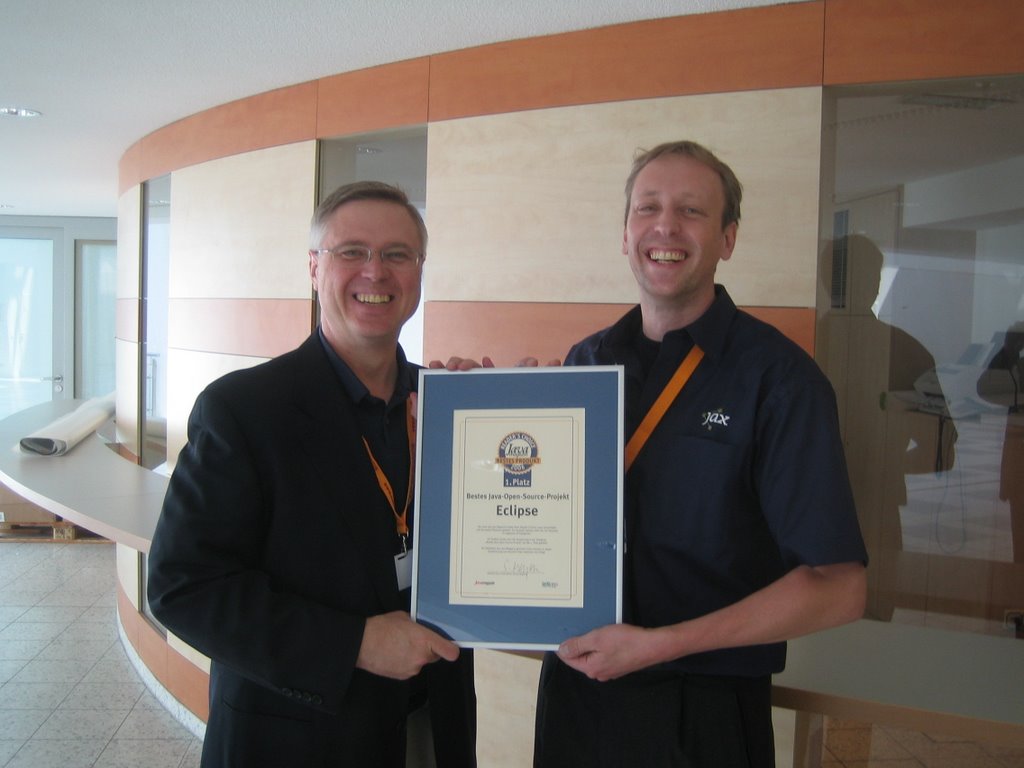
While at JAX, the editor of JavaMagazin, Alexander Neumann presented Eclipse with their Reader’s Choice Award for Best Open Source Project. Congratulations to the entire Eclipse team!
This week I’m off to JavaOne, where Bjorn and I are giving a talk on the Callisto Simultaneous Release. If you’re there, please say hi, and don’t forget to join the party at the Thirsty Bear.

