Posts Tagged ‘theia’
Celebrating Eclipse Theia’s Milestone: Full Compatibility with VS Code Extension API
We are thrilled to announce a landmark achievement in the evolution of Theia: full compatibility with the Visual Studio Code (VS Code) extension API, marking a significant milestone in the journey of Theia towards becoming a universally adaptable development environment.
Unleashing a World of Features with VS Code Extensions
Theia has supported hosting VS Code extensions for many years. The integration of the VS Code extension API unlocked an unprecedented array of features for Theia-based applications. This compatibility means that users can leverage the extensive ecosystem of VS Code extensions, bringing thousands of new capabilities to Theia. With the completion of a recent initiative, Theia now is fully compatible with the VS Code API allowing the vast majority of VS Code extensions to be used in any Theia-based application. Of particular note is the recent addition of support for notebook editors, a game-changer that opens Theia to new audiences, such as data scientists, who rely heavily on notebook interfaces for languages like Python.
A Symphony of Collaboration
This achievement is not just a technical milestone; it is a testament to the power of collaborative open-source development. The original VS Code API compatibility implementation was contributed by Red Hat. The journey to full compatibility, initiated by STMicroelectronics and crafted through the concerted efforts of EclipseSource, Ericsson, Typefox, and other contributors, has been one of shared vision and united effort. STMicroelectronics and EclipseSource played a pivotal role in establishing an open, structured process for regular API comparison and issue tracking. This approach facilitated a broad-based contribution, allowing various organizations to contribute effectively to the project.
Empowering the Developer Community
The compatibility with the VS Code API multiplies Theia’s effectiveness as a development platform. For developers, this means access to the latest and most advanced tools available in the VS Code ecosystem, significantly enhancing both the adopter and user experience with Theia.
Overcoming Challenges through Open Source Collaboration
The journey to this point wasn’t without challenges. Initially, contributions were focused only on specific missing API features needed for particular extensions used by contributors. However, the structured process initiated by STMicroelectronics set a new direction – aiming for complete compatibility. This approach significantly simplified the distribution and parallelization of work. As a result, this process galvanized the open-source community, leading to a surge in contributions and exemplifying the true spirit of collaborative innovation.
Maintaining the Pace: The Future Roadmap
For nearly half a year, Theia has maintained full compatibility with the VS Code extension API. The commitment to this standard is unwavering. With regular scans of new VS Code API updates, contributors that Theia stays in lockstep with the latest advancements, continually integrating new features and capabilities.
Join Us in this Continual Journey
As we celebrate this milestone, we also look to the future. Theia’s journey is ongoing, and the path ahead is as exciting as the accomplishments behind us. We invite the developer community, contributors, and enthusiasts to join us in this vibrant and continually evolving project. Together, we will keep pushing the boundaries of what’s possible in open-source development environments.
Let’s continue to shape the future of software development tools with Theia. Your contributions, feedback, and engagement are not just welcome – they are essential to our shared success.
Here are a couple of links to get you started in your journey with Eclipse Theia:
- Theia’s website
- Project overview page
- Github organization
- Project readme
- Getting started with Theia
- Contributing to Theia
Eclipse Theia is the next generation of Eclipse!
For over 20 years the Eclipse IDE platform, along with the Eclipse Rich Client Platform (RCP), have provided core technologies for building richly featured language IDEs, products, and applications that are portable across Windows, Mac, and Linux desktops. However, time moves on and the next generation of desktop products and applications are now being built with web technologies. In many scenarios there is a need to support both desktop and web deployments with the same functionality, and obviously those who have this requirement would ideally like to support it using a single platform.
With this shift towards web and cloud development, many Eclipse platform adopters are now evaluating how to best migrate their existing tools, IDEs and applications. One technology to consider is Eclipse Theia. Theia is a platform that can be used for building both web and desktop IDEs and tools, based on modern, state-of-the-art web technologies (TypeScript, CSS, HTML). This often leads to the question: Is Eclipse Theia the next generation of Eclipse?
EclipseSource, a member of the Eclipse Cloud DevTools Working Group, recently published a blog post asking this question. The article discusses requirements for a tool platform and how both Eclipse desktop and Eclipse Theia address these requirements. Ultimately, they come to the conclusion that Eclipse Theia can indeed be considered the next generation platform for building portable applications. And I agree. Eclipse Theia is indeed the next generation tooling and applications platform from the Eclipse Foundation!
Just to be clear, this is not an announcement of the deprecation of the Eclipse IDE, the Eclipse Tool Platform or Eclipse RCP. These projects are stable, widely used, well maintained, and will continue to be so for a long time. The timeframe of course depends on the health and activity of the ecosystem and the community, which is now the focus of the Eclipse IDE Working Group created last year to ensure the long-term sustainability of the Eclipse IDE and Platform. I highly recommend any company building products or critical business applications on the Eclipse platform to join that group. At the same time, we are clearly seeing a shift of developer tools and IDEs towards web-based technology, and ultimately the cloud. As a result, many projects currently based on Eclipse desktop technologies are asking what comes next.
The Eclipse ecosystem has always combined sustainability, innovation, and vendor neutral collaboration. For the last 20 years, the Eclipse desktop ecosystem has been an exemplar of this, and it will continue to be a focus of the Foundation. At the same time, we continue to innovate, e.g. with Eclipse Theia and other related technologies such as Eclipse Che, Eclipse GLSP, and EMF.cloud. This is the beauty of an industry-driven open source ecosystem like Eclipse. It addresses the requirements of adopters to have a stable platform, while also providing paths to move forward and innovate.
Despite not sharing a single line of code, in many ways Theia is an evolution of the Eclipse Tools Platform. Theia builds on wisdom distilled from two decades of engineering at Eclipse, in order to inspire the next generation. Besides the obvious benefit of simply offering a web-based technology stack, Theia is slimmer, and able to lean more heavily on aspects of the web technology stack. It does not, for example, provide its own UI technology (as Eclipse needed to do with SWT). It also doesn’t provide a new module system (as Eclipse did with OSGi). Instead, it is based on available technologies such as HTML/TypeScript, Node, VS Code extensions, and the Monaco Code Editor. This is great for the sustainability of the project. By maintaining less code and reusing more standard technologies, development resources can be focused more on the core capabilities of the platform.
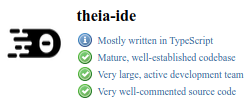
Theia also has a very healthy community of active contributors, adopters and funding organizations. It is seeing widespread and mainstream adoption, serving as the platform for notable commercial technologies, including the Arduino IDE, Arm’s mbed studio, and the Google Cloud Shell Editor. There is also a wealth of extensions freely available for Theia at the Open VSX Registry.

I should also point out that along with Theia, there are several additional technologies that help create a solid ecosystem for the next generation tool platform at the Eclipse Foundation. To mention just a few, Eclipse Che offers online workspace management; Eclipse GLSP provides support for building diagram editors in the browser; Eclipse CDT.cloud for building customizable web-based C/C++ tools and EMF.cloud moves the Eclipse modeling ecosystem to the web.
We are very happy to see Theia flourishing and the robustness of its community. Theia certainly is the central building block of the new generation of tools that want to benefit from web-based technologies and cloud deployments. And so, yes, in this context, Theia and its ecosystem can be considered the next generation of Eclipse Platform.
2022-04-19: Edited to update the contributors logo graphic
 Life at Eclipse