Archive for the ‘Foundation’ Category
Question Conventional Wisdom
As already referenced by Bjorn and Ward, this article by John Mark Walters makes for some very interesting reading. I highly recommend it, and I am already looking forward to reading the next one in his series.
The article has some interesting implications for Eclipse. I would venture to say that Eclipse stands out as an example of an open source community that has been very successful without being overtly religious or ideological about its motives. If anything, the mantra within the Eclipse community seems to be a pragmatic desire to help developers successfully adopt its technology. As such, John Mark’s article provides an interesting and plausible explanation for Eclipse’s success.
Java Detour
After the Eclipse Board and Council meetings I headed down to San Diego to meet with the Executive Committees of the Java Community Process. I was there to have a conversation on what Eclipse is and what we do. On the way to SFO, we drove by this coffee shop, which I thought was pretty fitting given all of the conversations last week about the road Java is on. 
The article from BusinessWeek certainly generated a lot of angst amongst the Java community, as you can see on JavaLobby and TheServerSide.
Personally, I disagreed with the basic argument in the article: that Java is taking a backseat to other languages and platforms. John Loiacono got it exactly right in his counterpoint in the article. It may be fun to write about the next shiny toy in the high tech universe, but the reality is that the vast majority of business applications and commercial systems need to be built on stable, proven technology. I am now getting old enough to have been through several hype cycles. In fact, I’ve now been through enough that I think they’re pretty damn annoying. But they are the engine that feeds the software industry machine, so I think we’re stuck with them.
I tried to make a point along this line when I compared Java to COBOL in my JCP talk, but apparently didn’t explain myself very well. What I don’t understand is why people think comparing Java to COBOL is a negative statement. I sure didn’t mean it as one. COBOL powered the business of the planet for an entire generation. It lasted for decades after its demise was predicted. This is not a comparison on a technological basis. It is a comparison of mainstream adoption, perceived stability, robustness and scalability.
For 20+ years if you were going to write a business application and you were thinking of writing it in a language other than COBOL, the onus was on you to explain why. That is pretty close to where I see Java today.
At Eclipse we use Java for most development, but we are not focused solely on Java. Two great examples: Zend recently joined to build PHP tools, and Eclipse’s C/C++ tools are widely adopted in the Linux and embedded markets. You can find Eclipse plug-ins for almost every language out there.
Is Java seeing some stiff competition for the hearts and minds of developers? Absolutely. As pointed out in the BusinessWeek article, PHP’s adoption is growing in leaps and bounds. And it is increasingly moving up the stack to become a more scalable and mature enterprise solution. It does not make sense to try to use Java for everything, but to carefully think through what is the best tool for each project. But that is not the same thing as saying that the end is nigh for Java. Personally, I believe that PHP and LAMP have been taking a far larger bite out of the Microsoft franchise than Java’s.
Can Java be improved? Absolutely, and that’s the conversation we had at the JCP. In my personal view, there is way too much “P” and too little “C” in the JCP. At its core, the Java community is a developer community. And in my view, communities such as Eclipse and Apache do a far better job of empowering the developers than the JCP in its current incantation. Java needs to figure out a way to harness the energy in the Java developer community, rather than contain it.
I think that most of the innovation in Java is happening outside of the JCP process. Which is a good thing, as innovation needs to precede standardization. But the missing link in the process is that the JCP then needs to learn how to attract the great new things being created in Java and bring them in (when appropriate) for standardization. Instead what appears to sometimes happen is JSRs are created to compete with ideas already implemented in the broader Java community. A bad idea, IMHO.
Eclipse Meetings

Every once in a while we try out something new and it really works well. Some months back I realized that Bjorn booked the Council meetings the same week as the Board meeting. It’s hard for me to be in two places at once. The solution? Co-locate the two meetings and see what we could do to spark interaction between the Board and Council members. It worked really well and thanks go to Bjorn, Ian and Sharon for all of the organization that went into making the meetings this week in San Francisco a success.
As usual, the best part of the event were all of the hallway and lunch time conversations. The group dinner at the Ponzu restaurant was a lot of fun as well.
One thing that really struck me as I looked around the room for our overly crowded plenary session — sorry about the size of the room folks — is the wealth of talent that is contributing to and leading the Eclipse community. There are some very bright folks leading the Eclipse projects, which makes for productive and insightful Council meetings. 
A special note of thanks goes to Steve O’Grady who joined us and gave a great talk on “Bottom Up Marketing”. Another set of rave reviews for Steve’s ideas.
Phoenix Rises
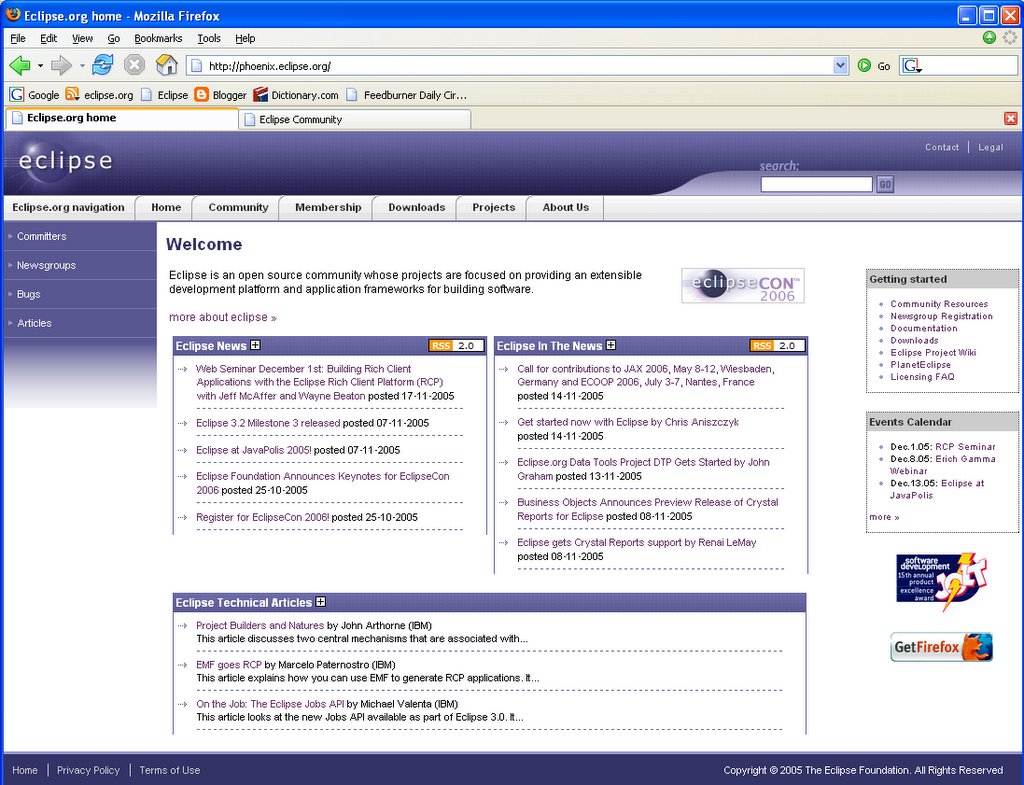
We’re getting close to the final countdown for our first release of Phoenix on Nov. 30th. Or, in other words, finally switching the www.eclipse.org home page over to our new look and feel.
The look and content have really come together in the last couple weeks and days. There’s nothing like U.S. Thanksgiving to make a team of Canadians more productive :-). The number of phone calls and emails have been real low this week.
There are still lots of links back to the old L&F/content. Those will take some time to gradually switch over. But IMHO, the new look and organization are a major improvement.
Here is a screen shot of the latest L&F for the home page. I strongly encourage everyone to go kick the tires on Phoenix and let us know your impressions. You can file bug reports here.
Open Budgeting
We’re currently going through the process of creating an Eclipse Foundation budget for next year. A major part of this process is deciding what programs we want to support.
We would all like to get community feedback on the programs we’re currently thinking about. Better yet, I would love to get some ideas for programs that we haven’t thought about.
So here’s what we’re thinking. For simplicity, I’ve lumped them into two categories: (a) those for the committers and projects and (b) those for the membership and ecosystem. The latter category would be traditionally thought of as “marketing”.
To be clear, there is no way we have the resources to do all of these, so feedback on prioritization would be helpful as well.
The full list of programs is on the Eclipse wiki, so please comment there.
 Life at Eclipse