Releasing Galileo
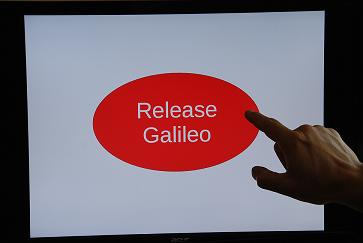
Denis pushes the Big Red Button
It was smooth as silk this morning as our esteemed Webmaster Denis Roy pushed the “big red button” to unleash Galileo. He had his moment of trepidation, but so far everything has gone very smoothly.
Thirty-three projects, 380 committers, 24MLOC+…this is a major software release no matter how you measure it.
Congratulations and thanks to everyone in the Eclipse community who contributed.
I would like to also take a moment to thank the people at the Eclipse Foundation who helped make it happen:
- Wayne Beaton, Bjorn Freeman-Benson, Anne Jacko and Gabe O’Brien for helping run the development processes over the past year. Supporting the Planning Council, getting the Reviews done and keeping the portal running are just a few of their contributions.
- Janet Campbell, Barb Cochrane and Sharon Corbett for getting all of the IP reviews completed. Eclipse’s well deserved reputation for care of our community’s IP is a big part of our success.
- Denis Roy, Matt Ward and Karl Matthias for keeping the IT infrastructure up and running flawlessly. Not just for the deluge of downloads, but keeping CVS, SVN, Bugzilla, etc. working throughout a year of development.
- Nathan Gervais for doing some very cool web design for Galileo. The look of the landing page, download pages, etc. is the best yet by far.
- Ian Skerrett and Lynn Gayowski for helping with the marketing launch for Galileo. Lining up the press interviews, etc. is a big job. Helping organize 30 democamps around the world is an even bigger job!
- Donald Smith for organizing a very cool Member Distro Download program.
Helping the community ship the release train is an all-consuming task for the staff here at the Eclipse Foundation. Each year sees incremental improvement, and this year was by far the best job yet. Congratulations and thanks to the team!
Berlin Board Stammtisch
Next week is our first-ever Eclipse Board of Directors meeting outside of the USA. Berlin is our destination, primarily based on the fact that it is a darn cool city.
Although Ralph won’t be able to join us, we are going to carry on the tradition he has created and have an Eclipse Stammtisch while we’re there. So Tuesday, June 16th is an opportunity for you to have a beer with the leaders of the Eclipse community.
If you can make it, please add your name to our Doodle poll. We’re hosting it at the Bavarium. Thanks to Eike Stepper for finding us a place on short notice.
We hope you can join us!
Some New License Flexibility
I have been remiss in updating our website with information regarding some decisions made by the Board late last year. Totally my bad.
So here is some good news:
- Projects can license their example code using the Eclipse Distribution License (EDL) as well as the EPL. The advantage to this is that it is clearer to Eclipse users that they can start with EDL-licensed example code when they are developing their products or applications. Because the EPL is a copyleft license and the definition of derivative works can be fuzzy, there can sometimes be confusion as to whether something which started its life as a piece of example code needs to be EPL-licensed or not. You can find details on how to apply this to your project in our policy document.
- Contributors of “non-code content” such as articles, whitepapers, etc. are now allowed to use two variants of Creative Commons licenses. This should make it easier for people to contribute their works to the Eclipse Resources library and other places on the Eclipse website.
If you have any questions on how to make use of these policy changes in your project, please drop us a line at “license at eclipse.org”.
I hope these improvements help!
Time Flies
Today is a bit of a milestone for me, as it is exactly five years since I assumed the role of Executive Director of the Eclipse Foundation.
I had an inkling that this was going to be a different kind of role when a few days before I even started a journalist by the name of Darryl Taft called my home to ask me if it was true I was taking the job. Being totally caught off guard, I think I said something dumb like “no comment”. Not an auspicious beginning for a very public position.
It is hard to over-state the early challenges we had getting the Eclipse Foundation up and running. Five years ago we had about fifty members, no staff, no bank account, no offices and the heat was on to take over the creaking IT infrastructure that was still hosted at IBM. The development and IP processes existed in paper form but had never even been tried for real.
Today we have over 170 members, seventeen wonderful staff in three locations and great IT infrastructure. Our development and IP processes have been refined through several iterations and are demonstrating real value to the committers, members and ecosystem at Eclipse. These processes are definitely not perfect, but they get the job done.
But the true excitement of being part of Eclipse has been seeing the original vision of a vendor-neutral open source foundation at the centre of a commercial ecosystem coming to fruition. That was the original vision of people such as Skip McGaughey, Dave Bernstein, Danny Sabbah and John Swainson. I am sure that there are others, and I apologize for not listing everyone. Those “founders” if you will deserve a lot of credit for getting the Foundation created and the Bylaws, etc. written.
Sure, we have no shortage of challenges, but today there exists a multi-billion dollar ecosystem with hundreds of companies and millions of developers using Eclipse. The growth in projects at Eclipse has been awesome to watch as well. The breadth of technology being developed at Eclipse would have been hard to even imagine five years ago. That is awfully darn cool.
This is a pretty tough job. It involves dealing with many different interests and trying to find workable solutions. Anyone who has known me for a long time will tell you that I am not a natural politician. But this has been the single most exciting job I’ve ever had and I look forward to the challenges of the next five years. We are not resting on our laurels here at the Eclipse Foundation. The best is yet to come.
EPL ~= ASL
Boy, am I on some kind of blog binge this week. It’s amazing how a few weeks without travel helps.
Dana Blackenhorn wrote a piece earlier today discussing Matt Asay’s article on why the Apache license is better than the GPL. In his article, he states the following:
If your company wants to release its own code, and control that code, if open source is mainly a marketing concept to you, then a BSD license such as Apache or Eclipse makes perfect sense.
Dana’s statement makes an error that I have seen repeatedly. Namely, that the EPL is a “BSD-style” license and is therefore similar or equivalent to the Apache license. This is just plain wrong. And it worries me that a long-time open source observer such as Dana would make this mistake.
The EPL is what is sometimes referred to as a “weak copyleft” license. It most certainly is a reciprocal license in the same way that the LGPL and the MPL are, for example. (The European Union describes the EPL as a strong copyleft license, in its paper describing license compatibility with the EUPL.)
In our view, the copyleft provisions of the EPL gives our community the best of both worlds. Yes, changes and modifications to EPL-licensed code need to be contributed back. This helps ensure that everyone involved is incented to make their contributions back to the platform, and encourages community building. But at the same time, because the EPL (a) does not define simply linking to it as creating a derivative work and (b) allows re-licensing of binaries under commercial terms, it encourages commercial adoption.

