Eclipse for the World
Perhaps it’s because of my recent trip to China, but it is becoming increasingly clear that internationalization is a very big deal for everyone in the software world. The ability to fully enable products and applications for double-byte and bi-directional languages is key.
Enter ICU4J. One look at the JDK to ICU comparison chart reveals why this library exists and is used by so many ISV’s out there today (e.g. Adobe, Apple, BEA, Cognos, Debian Linux, Gentoo Linux, IBM to name just a few).
I haven’t seen a lot of fanfare about this, but I consider including ICU4J in the Eclipse Platform for 3.2 and Callisto to be one of the biggest things going on right now in Eclipse. With Eclipse 3.2, developers are going to have a much more powerful tool for internationalizing their applications. With significantly better functionality than what is supported in the JDK. Now Java applications can be competitive those written in other programming languages in countries such as China, Japan and India. This is especially important for Eclipse and Eclipse RCP compete with Microsoft’s Vista release, as they are clearly focusing energy on ensuring strong internationalization capabilities.
But isn’t the JDK enough? Unfortunately not. From one of the documents from the ICU4J team:
“…as a platform, Java provides support for only a small set of locales (only 21 locales are officially supported, another 73 are shipped by not tested). By comparison, Windows XP SP2 supports 159 locales. In the set of 94 Java locales there is support for only one of the 22 official languages of India, one of the fastest growing economies in the world…”
ICU4J supports and ships twice as many (over 230) locales as Java. And there are other important features as well, such as support for better/faster sorting, enhanced date formats, better calendaring options and the like.
So keep an eye on development with ICU4J. It’s just recently been included in the platform builds. Next is switching the 3.2 stream over to use it, and then for the rest of the Callisto projects to make the jump. The changes are minimal, so hopefully the switch will be relatively quick and painless.
Election Time
It’s February so that means its election time in the Eclipse community.
Each year, the committer community and the add-in provider community vote for their representatives on the Eclipse Board of Directors. The number of elected reps is calculated using a formula based on the number of strategic members. The formula is 1+(floor(# of strategic members) / 5)). For this year, this means we’re electing four committer reps and four add-in provider reps.
This year there is a great slate of candidates with some very interesting thoughts on how they can contribute to Eclipse by participating on the board.
I strongly encourage everyone within the Eclipse community to get involved in the election by posting questions and comments to the candidates on the eclipse.foundation newsgroup (news, http). Even if you can’t vote, I would love to see some lively threads discussed on the issues.
A Comic Moment

I finally have a moment — and the picture thanks to John — to mention this truly comic moment in Beijing. As John Kellerman and I were doing our lightning tour of the Forbidden City, this class of girls came up and asked to get their picture taken with us. Near as we could figure out, they were from a small city in the interior of China and we were amongst the first foreigners they’d met. It was very near Chinese Lunar New Year when we were there last week, and many schools were doing tours during the holiday break.
The smiles on everyone’s face say it all.
Brand Hijacked
 I’ve been noticing an interesting trend in the worldwide ecosystem growth of Eclipse. No longer content with just focusing on software and developer tools, the Eclipse community has begun to branch out into new areas. Among them: UK-based courier services and Canary Island real estate. As evidence, take a look at these photos taken by alert Eclipse fans in their travels. Don’t the logos look familiar?
My guess is that these companies thought “Eclipse” was a good name and did a quick internet search for artwork. Googling “eclipse artwork” brings you directly to our artwork page, which has a full collection of high-quality vector artwork for the Eclipse logos available under the EPL. So the community that started with a vision of plug-in re-use has spawned a whole new genre: logo re-use.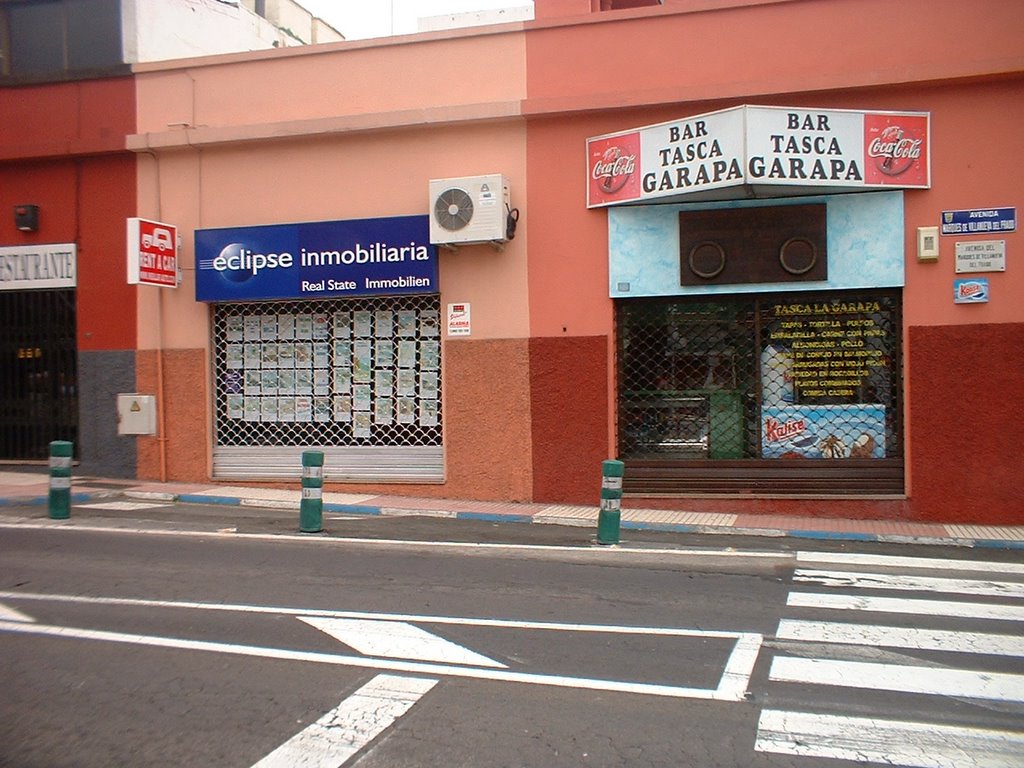
Too funny.
Oh, and by the way, one of the best business books I’ve read in the past year has been Wipperfurth’s Brand Hijack. I highly recommend it.
Eclipse in Bejing
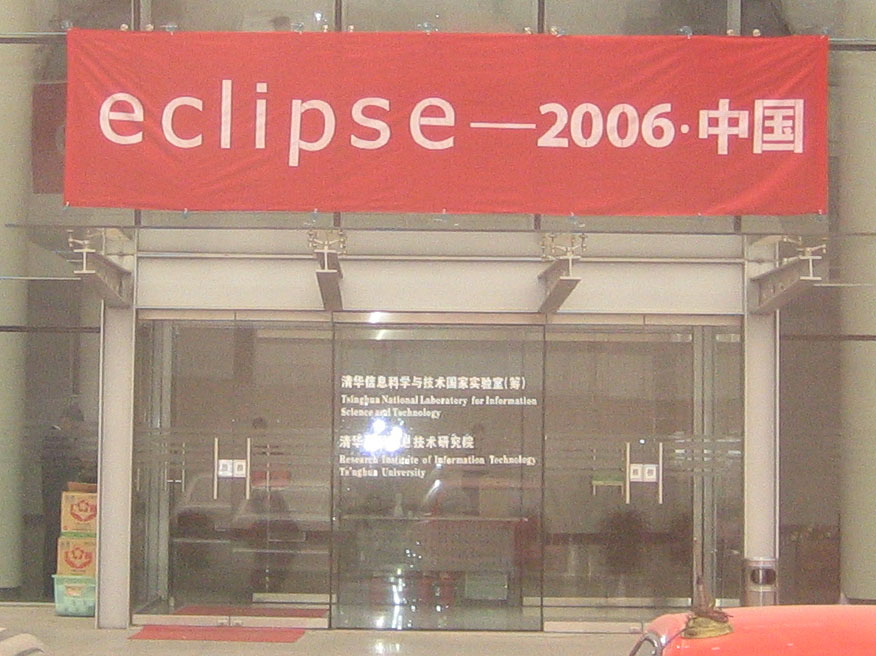 I’m heading to the airport soon, and wanted to blog about the week before leaving.
I’ve been in Bejing this week for the first annual Eclipse Day in China. This event was hosted by Tsinghua University, the premier technical university in China. (Sometimes referred to as the “MIT of China”.)
The Eclipse Day was sponsored by Actuate, HP, IBM and Sybase, all strategic members of Eclipse.
Here’s a little known fact: between Actuate and Sybase, there are around 50 Eclipse committers located in Shanghai, which I believe makes China the third largest country in terms of Eclipse committers. (US and Canada being #1 and #2 respectively.)
The Eclipse Day was a huge success. We were trying to be conservative as it was our first event in China and planned for 100 to 140 attendees. By lunchtime, 230 attendees had registered. Apparently, there are a lot of organizations using Eclipse in China. There were attendees who had used just about every one of the major Eclipse projects, and the RCP session was packed.
This is my first trip to China, and it has been a wonderful experience. Sitting beside me on the flight from Vancouver was Maurice Strong who has been coming to Bejing regularly for 40 years. He told me to expect to be surprised, and I was. I’ve never seen hyper-modern so closely juxtaposed with the ancient.
Here’s a picture of John Kellerman of IBM and I playing the tourist on the Great Wall of China.
 Life at Eclipse