Differentiating Communities
I was asked earlier today if I could describe “…the Eclipse community and its differences between other traditional commercial open source communities say like Sugar’s and non, or less pure commercial communities like Apache.”
Darn good question. Off the top of my head here are a couple of key differentiating points. I would certainly be interested in hearing the views and comments of others. Both from Eclipse and from other communities.
- I actually don’t think of the likes of Sugar or MySQL as “traditional” open source communities. I think of them as corporately owned communities. Yes, there are vibrant communities there, but the intellectual property is owned by a single vendor backed by investors with an expectation that a profit will be made and that an exit will be had.
- Communities such as Linux, Apache and Eclipse are distinctive in that they are either not-for-profit or non-profit and have a legal requirement to be vendor-neutral and a community requirement to respect the principles of openness, transparency and meritocracy. They are not motivated by their own profit, but are motivated to see the businesses of their stakeholders be profitable. As such, they are trusted agents at the centre of the business ecosystems that they create, in ways that a for-profit vendor could never be.
Eclipse is differentiated from Apache in many ways. But here are a few to think about:
- First, our interests in creating a commercially profitable ecosystem are more overt. Obviously, there is a very vibrant ecosystem that has sprung up around many of the Apache projects and the Apache folks are happy about it. But at Eclipse it is a stated directive for the staff of the Foundation to help foster that commercial success, rather than a side effect. We work every day to attract companies to use technologies from the Eclipse projects.
- Secondly, the Eclipse community is working on a single technology platform, so every Eclipse project can inter-operate with the others at some level. Since we are using a common technology platform (Equinox OSGi) and since many of our developers are paid to be full-time Eclipse developers we can do things like ship an annual release train where dozens of Eclipse projects release simultaneously. (This year there were 37 projects that shipped together.) These release trains form the technology platform for the Eclipse ecosystem to build products on for the next year. We now have a track record of shipping six years in a row with the release train on schedule to the day.
- Thirdly, as a matter of culture Apache uses “community before code” as its mantra. We don’t run around saying this but the reality is that at Eclipse we value “code before community”. Diversity and community are one measure of the health of an Eclipse project but in the end we really care about the code quality and commercial adoption of an Eclipse project when we think of it as a success. The Eclipse projects that manage to do both are the ones we consider our home runs.
So vive le difference!
There are obviously some gross generalizations in the above, but I think I successfully captured some of the key points. Anything I missed? Anything blatantly dumb?
Welcome to the EPL
A bit of good news for the Eclipse Public License this morning comes from Intuit, which announced that their community site code.intuit.com will be using the EPL.
Intuit had previously decided to use the Common Public License, but when we pointed out that it had been superseded at the OSI by the EPL, they agreed that it made sense to go with the EPL. It turns out that some of the links and pages at the OSI had not yet been updated, and thanks goes to Russ Nelson for fixing those quickly!
All-in-all a good outcome for the EPL. It’s great to see the increasing adoption of our license by the broader open source community. It is now the license used by the Topcased and Symbian communities as well as a growing number of projects on code.google.com and sourceforge.
Time to Git Some Progress
Git has been growing in popularity, and I am particularly interested in its potential to reduce barriers to participating and contributing to Eclipse projects. There has been a vigorous conversation about using Git for Eclipse projects going on for some time over in bug 257706, including my own reservations about the idea. But it is clearly time to start making some progress on this topic.
In talking with Wayne, Denis and the committer reps on the Board of Directors, it seems that the most obvious place to start would be to have Git installed on our servers and providing a read-only cache of the work of all projects. The projects themselves will continue to use CVS and SVN. (see bug 280583)
I am personally willing to consider a future where Git becomes the standard SCM at eclipse.org, but time will tell if we can get there.
How can you help?
- Give us feedback on this idea, either in the comments here or in the bugs mentioned above.
- If you are involved in an Eclipse project and you would consider switching to Git, please start the conversation with your peers. Would someone be willing to start and maintain a list of willing projects somewhere?
- Get involved in the eGit project. The faster we have a first class team provider for Git, the faster we can use more Git at Eclipse. The CVS plug-in for Eclipse does truly rock, and there are lots of people at Eclipse who will not even consider switching if Git is not supported with equivalent function and stability
Releasing Galileo
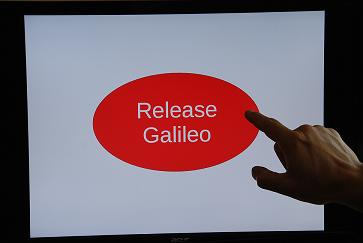
Denis pushes the Big Red Button
It was smooth as silk this morning as our esteemed Webmaster Denis Roy pushed the “big red button” to unleash Galileo. He had his moment of trepidation, but so far everything has gone very smoothly.
Thirty-three projects, 380 committers, 24MLOC+…this is a major software release no matter how you measure it.
Congratulations and thanks to everyone in the Eclipse community who contributed.
I would like to also take a moment to thank the people at the Eclipse Foundation who helped make it happen:
- Wayne Beaton, Bjorn Freeman-Benson, Anne Jacko and Gabe O’Brien for helping run the development processes over the past year. Supporting the Planning Council, getting the Reviews done and keeping the portal running are just a few of their contributions.
- Janet Campbell, Barb Cochrane and Sharon Corbett for getting all of the IP reviews completed. Eclipse’s well deserved reputation for care of our community’s IP is a big part of our success.
- Denis Roy, Matt Ward and Karl Matthias for keeping the IT infrastructure up and running flawlessly. Not just for the deluge of downloads, but keeping CVS, SVN, Bugzilla, etc. working throughout a year of development.
- Nathan Gervais for doing some very cool web design for Galileo. The look of the landing page, download pages, etc. is the best yet by far.
- Ian Skerrett and Lynn Gayowski for helping with the marketing launch for Galileo. Lining up the press interviews, etc. is a big job. Helping organize 30 democamps around the world is an even bigger job!
- Donald Smith for organizing a very cool Member Distro Download program.
Helping the community ship the release train is an all-consuming task for the staff here at the Eclipse Foundation. Each year sees incremental improvement, and this year was by far the best job yet. Congratulations and thanks to the team!
Berlin Board Stammtisch
Next week is our first-ever Eclipse Board of Directors meeting outside of the USA. Berlin is our destination, primarily based on the fact that it is a darn cool city.
Although Ralph won’t be able to join us, we are going to carry on the tradition he has created and have an Eclipse Stammtisch while we’re there. So Tuesday, June 16th is an opportunity for you to have a beer with the leaders of the Eclipse community.
If you can make it, please add your name to our Doodle poll. We’re hosting it at the Bavarium. Thanks to Eike Stepper for finding us a place on short notice.
We hope you can join us!
 Life at Eclipse